Friday, September 2, 2016

The State of Politics & The Press in 1874

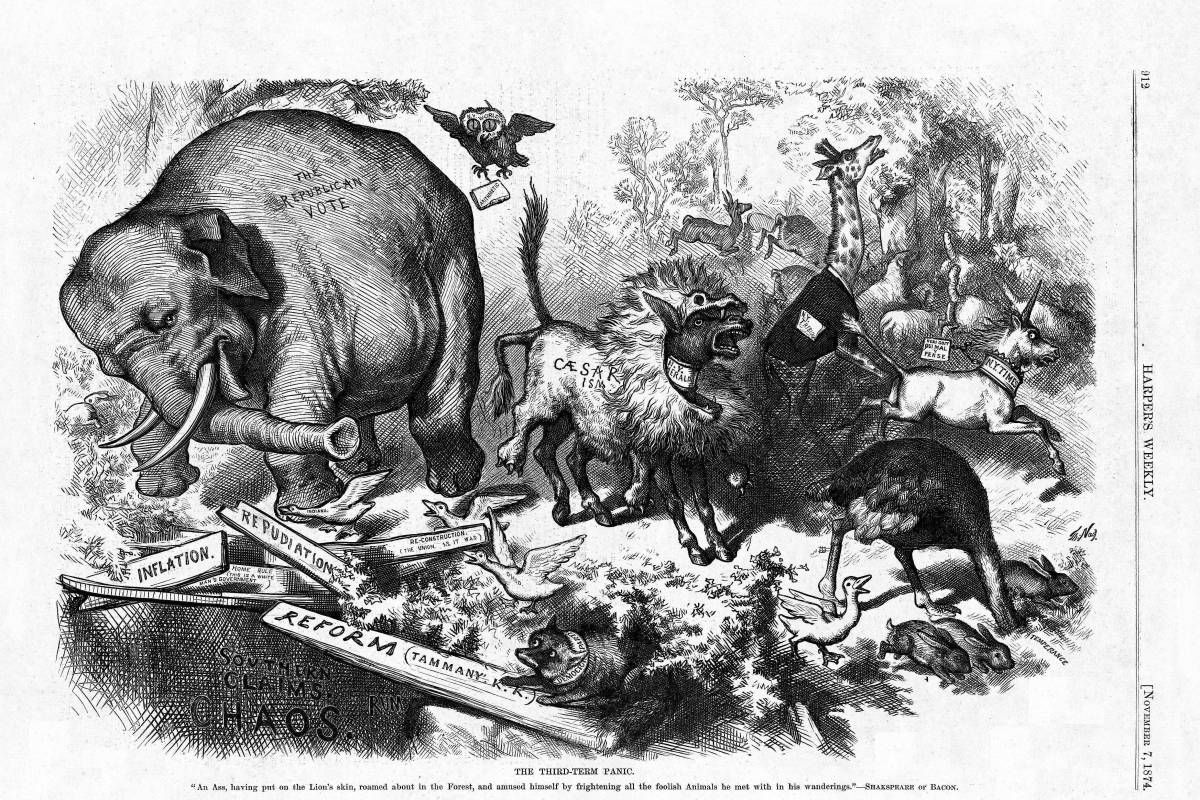
The State of Politics & The Press in 1874 - same as it ever was:
(Ref: Thomas Nast's famous political cartoon)

https://upload.wikimedia.org/wikipedia/commons/2/27/NastRepublicanElephant.jpg
The Donkey was NOT being used here to represent the Democratic Party!
He is an ASS representing the NY Herald newspaper!
  • The NY Times is shown as a unicorn (about right)
  • Other NY press are shown as confused or frightened (NY World owl, NY Tribune giraffe)
  • "Honi soit qui mal y pense" is used here to ironically insinuate the presence of hidden agendas or conflicts of interest
  • The Temperance movement is an ostrich with it's head in the ground
  • The Democrats are represented as a timid Fox resting on a Reform plank (but, they are "reforms" according to his Tammany Hall bosses)
  • A panicked Republican elephant is stomping about wildly (this cartoon served as the origin of the Elephant as the party's symbol)
  • The planks represent ineffective solutions over a Black Hole of "Chaos" then facing the country, including: 
    • nativism
    • rapid immigration
    • Anti-Catholic fears
    • Repudiation
    • Home Rule/"white man's" government
    • post-war Southern Claims
    • Reconstruction
    • Demon Rum (got to blame something)
    • an unpopular Congressional pay raise
    • the Panic of 1873 financial crisis (it used to be called the Great Depression until 1930)
    • economic inflation
    • and the rise of global protectionism. 
 (Sound familiar?)


Thomas Nast's caption: "An Ass, having put on the Lion's skin, roamed about in the Forest, and amused himself by frightening all the foolish Animals he met with his wanderings." 
- Shakespeare of Bacon
originally published in Harper's Magazine 7 November 1874

Tuesday, July 5, 2016

Independence Day . . . don't take it for granted


Originally Published June 27 at 3:18pm on Facebook

Reading up on family connections associated with the American War of Independence. This one was interesting:

Adam Lugar came to America as a Hessian soldier to fight for the British, but almost immediately deserted and joined the rebellion. Adam fought with Casimir Pulaski’s line for 18 months and afterwards for another 6 months in North Carolina. Shortly after the Revolutionary War, Adam and Polly Lugar were married in Guilford County, NC and settled in what was then Montgomery County, in northern Virginia. Their son George Lugar relocated to Grant County, Indiana in the late 1820s, settling near the town of Marion. Adam and Polly were the 2nd great-grandparents of Cora Viola Rowe, grandmother of my mom Betty Thompson. 


Here is a Google Earth shot of the general area in Craig County, Virginia where Adam Lugar lived in the late 1700s and early 1800s. This is looking north from along VA Highway 42 (also called Cumberland Gap Road). The dark green hills in the background are along the West Virginia state line. The valley behind the first patch of trees is Sinking Creek. The Appalachian Trail runs through this valley, right to left (east to west). The surrounding area is called Level Green and the family homestead was called Lugar Hill, located about 20 miles northeast of Blacksburg, Virginia. The Fairview Cemetery, where Adam and Polly are buried, is within a mile of here.

Wednesday, June 10, 2015

The Underground Railroad’s secrecy is legendary . . .

It is common knowledge that the Underground Railroad was active through Sullivan County, Indiana in the early/mid 1800's. But there is little documented evidence . . . (all according to plan!)

"Safe houses" were located all along a route that roughly followed the Wabash River from Evansville through Vincennes to Terre Haute, and onward to the north.  In February of 2014, there were two video reports about the route presented by WTHI-TV, which concentrated on a hidden cellar at Bloomingdale in Penn Township, Parke County, which may have been used by travelers.


   Part 1: http://www.youtube.com/watch?v=r8uDwOTHOlM
   Part 2:
http://www.youtube.com/watch?v=cvItFV5Nl6s


The WTHI report Searching for History begins with an understatement: “The Underground Railroad’s secrecy is legendary. . .”

So secret that there’s not much known about the section of the “Blue route” shown; which ran from Vincennes, through Knox, Sullivan, Vigo and southern Parke Counties, until it reached the relatively safe Quaker communities of Penn Township. (I have seen one version of this map in which the segment from Vincennes to Terre Haute is shown a a dashed line.) As the WTHI reporter states: "it was said that when you made it to the banks of the Terre Haute Wabash, you were nine tenth of the way to freedom".


The "Blue route" shown in the video ran north through Sullivan County near Merom, then along the old "military road" west of Graysville, past Riverview, and then along the west side of Prairie Creek into Vigo County. However, there is almost no evidence for who was involved.

The Quaker community at Bloomingdale has direct connections to other "Carolina Quaker" groups who migrated in large numbers to Indiana and settled around the towns of Prairieton, Prairie Creek and Fairbanks around 1820. They were also directly connected to Quaker communities that earlier had settled along the East Fork of the Whitewater River in Wayne County, around 1806. The town of Fountain City and the city of Richmond are especially proud of their Quaker heritage. Other related Quaker communities were located near Danville in Hendricks County, and Mooresville in Morgan County. Many of these Quakers were from Guilford County, North Carolina; coming from Quaker Meetings at New Garden and at Deep River, near the present-day city of Greensboro. Our Hunt family ancestors were originally from northwest of Greensboro, near the present-day campus of Guilford College.

Of the people mentioned in the WTHI report, there are several connections to our family, and to these previously mentioned Quaker communities:

As a young man, Levi Coffin stayed in Vigo County for about a year (1826) where he helped set up a school for the Honey Creek Quaker Meeting. In his book "Reminiscences of Levi Coffin" he mentions visiting his friends in "Termin's Creek" (an early name for the village of Fairbanks); and says that he spent a week there visiting and hunting with the Dixes, Hunts, and his old friend David Grose (Gross). These Hunts may have included our 3rd great-grandparents Zadoc and Margaret (Johnson) Hunt, parents of Beulah (Hunt) Thompson. Levi Coffin was a 2nd cousin to Zadoc Hunt's father, Eleazer Hunt; related through their mother's families. These Hunt ancestors were also close relatives to John Woolman, an early Quaker abolitionist from Burlington County, New Jersey, who died just before the Revolutionary War.

The "WW Coffin" listed on the Parke County map would have been William Wilshire Coffin. His father Jethro Coffin was a 1st cousin to Levi Coffin; related of course on their fathers' side of the family.  

One of the names on the Penn Township plat map was "A Hunt". This was possibly Abner Hunt, an early settler in that part of Parke County. Abner was a 1st cousin to our Eleazer Hunt, but also he was married to our great-Aunt Mary (Rayl) Hunt; a sister to 4th great-grandmother Elizabeth (Rayl) Johnson. There were several other Hunt and Rayl relatives who settled in this community.

The monument shown at Bloomingdale was in honor of Alfred and Rhoda (Vestal) Hadley. Their families were among the early settlers of Hendricks and Morgan Counties. While not directly related to our ancestors (that I know of), there were many Hadley's married to our Hunt cousins within those communities. Some family names of these cousins include: Hunt, Rayl, Stanley, Hiatt, Mills, Carter and Dixon. Our 4th great-grandparents, Caleb and Elizabeth (Rayl) Johnson are buried in Hendricks County in the Quaker cemetery north of Amo, Indiana. This Caleb Johnson was the namesake of our grandfather's Uncle Caleb Johnson Thompson.

Another possible link to the Underground Railroad for our ancestors might involve the Union Christian College at Merom and the Big Spring Church west of Graysville. Both places were located along the old military road that ran from Vincennes to Terre Haute. The Phillips family farm was next to the Big Spring Church. The Phillips' ancestor was Elder John Phillips, who had raised money through the Christian Church to help start the college. Another
Phillips ancestor, 3rd great-grandfather David Cushman, who grew up a Quaker, served as an early trustee of the college. The founders of the Union Christian College at Merom were openly anti-slavery, and as a consequence they once had to defend the school from attack by hooded members of the Knights of the Golden Circle, who unsuccessfully attempted to burn the building. The Phillips' had moved to Graysville in 1854 from Yellow Springs, Ohio (another important Underground Railroad stop), where the Rev Phillips had helped establish Antioch College, and where he was on their original board of trustees. 
As can be seen, there are many corroborating relationships and connections among these families. Considering that they lived all along the Underground Railroad routes shown in the video, it seems  likely that they would have been involved in, or at least aware of, what their family and friends were up to. But as the reporter says, "some of the records of the people involved were taken to the grave."

Thursday, April 23, 2015

Elder John D Phillips of Turman Township, Sullivan Co., Indiana


Elder John Phillips and wife Ruth (Gifford) Phillips moved from Turtle Creek Township, Warren Co., Ohio to their farm at the Big Spring near Graysville, Indiana shortly after 1860.
Elder Phillips was a “New Light” minister associated with the Big Spring Christian Church (Christian Connexion). This congregation had direct ties to the formation of the Union Christian College (UCC), which existed from 1858 through 1924 at Merom, Indiana.  The Rev. E. W. Humphreys first establish a small academy in Merom in 1854, a year in which Humphreys was also a founding member of the Big Spring congregation.  Upon returning from a trip to Europe in 1858, Humphreys began promoting formation of a formal liberal arts college at Merom to be under control of the Christian Church. The resulting campus and the old College Hall (built in 1859) are now part of the Merom Conference Center operated by the United Church of Christ.  
Elder John Phillips of Ohio, well regarded as a business agent and a proven solicitor, was recruited by the group at Merom to help coordinate their campaign. Their competitive proposal won out over other pledges from much bigger towns; including: Lebanon, Kokomo, Logansport, Peru, Anderson, Attica, Richmond and Sullivan. During formation of the school's charter, it was determined that the school would be coeducational, and that women could take any course that was available to the men. UCC was one of the earliest colleges to formally adopt this policy.
Once the Merom proposal was accepted, John Phillips moved his family from Ohio and established a 640-acre farm near Graysville in Turman Twp., Sullivan Co., Indiana.  Elder John served as a trustee during the formation of at the new college at Merom, and also served on the board of trustees for Antioch College in Yellow Springs, Ohio.
The Big Spring Christian Church building was completed in 1868, located on property adjoining the Phillips’ farm.  That same year, Elder John Phillips was fatally injured, having been thrown from his horse while returning from the Sullivan County Fair. His son John T. Phillips later served as pastor of the Big Spring Christian Church and was on the Executive Committee of the Union Christian College. Another son Leander Phillips lived along the lane that ran south from the church building back to the Big Spring grove. (Leander was the grandfather of Leo S Phillips and great-grandfather of Robert H Phillips.) The Phillips family members are buried in the Mann-Turman Cemetery.
Elder Phillips had been previously engaged in the formation of Antioch College at Yellow Springs, Ohio, founded in 1850; where he served on their first board of trustees. John Phillips was on “The Committee on the Plan for a College,” formed to undertake the founding of the college, and to make decisions regarding the name of the school, the endowment, fundraising, faculty, and administration. This committee decided that the college "shall afford equal privileges to students of both sexes"; a radical idea in 1850.
In the 1850s, two African American girls, residents of Yellow Springs, enrolled at Antioch Preparatory School, which was then an official part of the College. A member of the board of trustees quit in protest and removed his own children from the school, but the Hunster sisters stayed in the school. In 1863, Antioch trustee John Phillips proposed a formal resolution stating "the Trustees of Antioch College cannot, according to the Charter, reject persons on account of color." The resolution passed with nine trustees in favor and four opposed. However, there were no black students at Antioch for many decades until Edythe Scott was admitted in 1943 with a full scholarship under a new racial integration policy. Two years later Coretta Scott (King) followed her sister Edythe as a student at Antioch.

Ref:  “The Origin of Union Christian College” Dr. James B. Maple Scrapbook No. 06;
Wabash Valley Visions & Voices - Sullivan County Public Library WV3 collection
Ref:  “Merom Conference Center”; Wikipedia article
Ref: Records from the Merom Conference Center, which include minutes and church membership records of Big Spring Christian Church from 1867-1961, are archived at the Indiana Historical Society library in Indianapolis.


Saturday, February 21, 2015

Great Dog Convention . . . there's an explanation for everything

Great poetry . . . from the early 1900's

The Dog Convention
There was a Great Dog Convention.
They come from near and far.
Some came on bicycles,
and some they came in cars.
Y'know, before they could enter,
or even take a look,
they had to take their asshole off,
and hang it on a hook.
But before they even got seated,
(every mother, pup, and sire),
An old dog hollered from the back,
Run for your life. It's a FIRE!
The crowd of dogs began to panic,
and nobody stopped to look.
They grabbed the very nearest asshole,
off the very nearest hook.
And this is why, even today,
a dog will drop a bone,
to sniff another doggie's butt,
to see if it's his own.

Thursday, October 16, 2014


The Legend of Bricktop


Location: Shelburn, Sullivan Co., Indiana

This story is as related to me by my grandfather, Walter E Thompson.

When Walter was a young boy in the early 1900’s, there was a local legend in Shelburn about the grave site of a man known as “Bricktop”. The ghost of Bricktop was known to inhabit the woods and fields along the railroad tracks south of town, where he was buried in an unmarked grave. So, along about Halloween time, it was customary for the older kids to take the younger ones on a hike down along the tracks to that haunted place, where the legend could be properly told.

The tale begins with the arrival of two strangers at the Shelburn train depot located south of the town center. One of the men was an unusually tall, red-headed man from Louisville who had accompanied the other man who owned some land out west of town. The men walked out to the property, with the purpose of selling either the land or the timber rights to the red haired man. Later that day, the dying body of the other man was discovered, badly beaten and stabbed, in the woods along the road west of town. In his dying breath, the other man identified the “brick-topped” man as the one who had robbed and accosted him. An alarm was quickly raised, the sheriff was alerted, and “Bricktop” was quickly apprehended at the depot, anxiously awaiting the next train out of town.

Bricktop was immediately arrested and he admitted his guilt, but by then the now large and unruly crowd was incited into exacting some immediate justice. The crowd transformed into a lynch mob, and the guilty man was escorted to the east end of town where he was “strung up”, hanged by the neck until he was dead.

So what do you do with the body of a no-count murderer? Such a disgraceful person did not deserve the dignity of a Christian burial in the consecrated ground of a local cemetery. None of the locals wanted him laid to rest in their proper cemeteries, which were mostly located next to a church. The Little Flock Cemetery was the closest burying grounds, and included a section for Hamilton Township burials which was separate from the cemetery for the Baptist Church located there. But, no; the locals didn’t want the murdering thief buried next to their friends and loved ones.

In the end, it was “Uncle Billy” Higdon who provided a plot, located on his farm property along the railroad right-of-way, as a burial place for Bricktop’s body. The unmarked grave is about a half mile south of town in a wooded area, next to the tracks. However, Bricktop’s grave was aligned in a north-to-south direction, parallel to the tracks, rather than the traditional alignment where the body is facing to the east on judgment day. The superstition grew that Bricktop’s ghost inhabited that area, and a tall, redheaded man was occasionally spotted by passing train engineers or passengers.

According to Walter Thompson, after the telling of the story (in an appropriately scary voice, of course), the younger children were encouraged to recite “Bricktop, Bricktop, whatcha doin’ down there?” And of course, Bricktop, he said “Nothin”.


(note: William W “Uncle Billy” Higdon was the grandfather of Walter E Thompson & of Herschel V 'Shorty' Bennett, who owned the drug store which is now home to the Sullivan County History Museum.)


Historical Background
The accounts of this legend are based upon an actual incident, as reported in the History of Greene and Sullivan Counties, State of Indiana (Ref: Chapter VII, History of the Bench and Bar Continued, by Sewell Coulson – pg. 557). These events took place around 1865, towards the end of the Civil War.

The Murder of a Stranger

“At this same term of the Circuit Court, the grand jury returned an indictment against Hayden Cuppy, William W Rogers and James T Allen, charging them with the murder of a stranger, by hanging him by the neck. The circumstances of the case were substantially these:

Shortly previous to the sitting of the grand jury, two strange men, claiming to be from Louisville, Ky., got off the cars at the town of Shelburn, and started to the country for the ostensible purpose of looking at some land one of them claimed to own, and proposed to sell to the other. They had not been long gone when one of them returned. Some time during the day, a lady and some children were attracted into a thick wood by the moans of a person, when they found the other stranger apparently in a dying condition. He had been beaten over the head with a club in a terrible manner, and had been robbed of all his money and other valuables carried upon his person. The news of the supposed murder and robbery spread rapidly, and soon there were several hundred people on the ground. That man that had returned to Shelburn was recognized as the person that had got off the train in company with the murdered man. He was promptly arrested, and admitted his crime. He was taken to the woods east of Shelburn, and, in presence of a crowd of from five to seven hundred people, was hanged. The cause (sic) was not tried till the February term, 1867, and the defendants were admitted to bail in the sum of $5,000 each.”

Title: History of Greene and Sullivan Counties, State of Indiana, published by Goodspeed Bros. (1884)
Repository: Book purchased from Sullivan County Historical Museum


by Todd J Thompson (Oct 2014)
Sunday, June 1, 2014

Cousins & Other Close Connections


Grace E. Yeager Hunt, and mother Maggie Wilson Yeager
Find-A-Grave website (photo submitted by Dr. Jon Tyler Conner)

I ran across this photo recently on the Find-A-Grave website, and after at first thinking the names sounded familiar, I then realized why. Besides making for a striking photo, this pair help illustrate how closely interrelated our neighboring communities were in and around Sullivan & Vigo Counties.

This mother-daughter photo is of Grace Ellen (Yeager) Hunt and Margaret ‘Maggie’ (Wilson) Yeager. (This photo would have been taken in the mid-1890s.) Maggie, the daughter of Henry Kouchman Wilson and Mary E (Mann) Wilson, was married to Warren Milton Yeager of Prairie Creek; second marriage for both.  Their daughter Grace would marry Arthur Hunt, also of Prairie Creek.

Through the Wilson family tree, Maggie was a 1st cousin to Tacy Margaret (Cochran) Smith, the grandmother of our grandmother Mildred (Smith) Thompson. Maggie’s husband Milton Yeager was a 4th cousin to Clara (Yeager) Phillips, mother of Leo S Phillips. Therefore, Grace was a 2nd cousin to our ‘Great-Granddad’ Edgar Smith, of Cass Twp., and a 5th cousin to ‘Grandpa’ Leo Phillips, of Graysville.

To round out our family connections, Grace’s husband Arthur Hunt was a 3rd cousin to ‘Grandpa’ Walter Thompson through their common ancestry (Hunt family from Guilford County, NC).  Arthur and Walter were also 4th cousins and 5th cousins through other lines of the Hunt family. Also, Maggie (Wilson) Yeager was a 1st cousin to Mary (Mann) Durham, the mother of Thomas Mann Durham who was married to Ruth (Eno) Durham, 1st cousin of 'Grandma' Helen (Cushman) Phillips.
Got it all?